GPhC Registered: 9012621
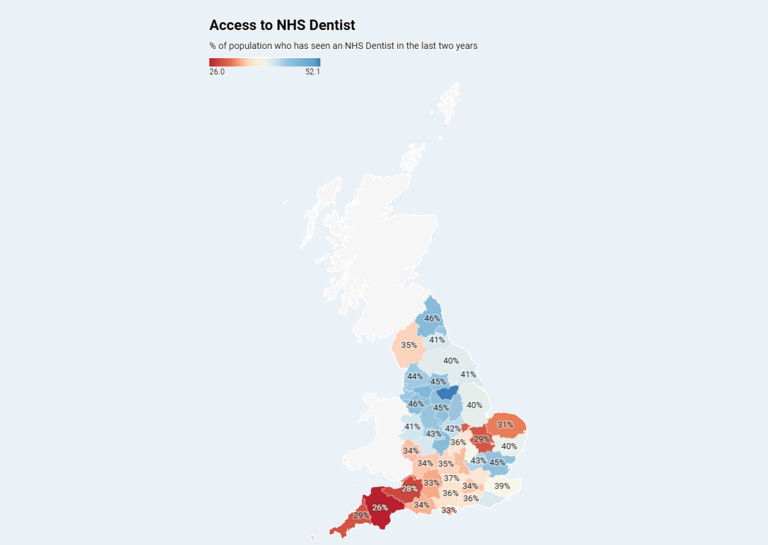
Access to NHS dental care varies significantly depending on where you live in England, with new analysis showing that six in ten adults have not been seen by an NHS dentist in the past two years.
Analysis by My Chemist Plus found that the proportion of adults seen by an NHS dentist has fallen from 51.4% a decade ago to 40% in 2025/26.
In some parts of England, access is considerably lower, with only around one in five adults having been seen by an NHS dentist within the previous 24 months.
Use our interactive map below to explore NHS dental access where you live
NHS dental access has fallen over the past decade
In 2016/17, 22.2 million adults in England had been seen by an NHS dentist within the previous two years. By 2025/26, that figure had fallen to 18.8 million.
Combined with growth in England’s adult population, this means the proportion of adults accessing NHS dentistry has fallen from 51.4% to 40% over the past decade. The national figure also hides substantial differences between different parts of England.
Where is NHS dental access lowest?
The three regions with the lowest proportion of adults seen by an NHS dentist are all in the south of England.
The South West has the lowest rate at 30.6%, followed by London at 36.9% and the South East at 37%. At the other end of the table, access is higher in the North West, at 45.5%, and North East and Yorkshire, at 44.5%.
The South West has experienced a particularly sharp change. Ten years ago, 51.7% of adults in the South West had been seen by an NHS dentist during the previous two years — approximately one in two adults. Today, that figure is fewer than one in three.
More people are looking for other ways to access dental help
Alongside falling NHS access, online search behaviour suggests that people are increasingly exploring alternative ways to get dental advice and treatment.
Google Trends data shows searches for “online dentist” and “private dentist” reached an all-time high in August 2026.
We have also seen growing demand for online dental services, with dental orders increasing by 23% in 2026, based on a comparison of May to August 2025 with the same four-month period in 2026.
These figures do not mean that online healthcare is replacing NHS or face-to-face dentistry. They do, however, suggest that some people are exploring private and online options when they are struggling to access care or looking for advice about dental symptoms.
What can an online dental service help with?
For appropriate cases, regulated online healthcare can provide a clinical assessment, advice and guidance on the right next step.
However, online healthcare is not a replacement for treatment by a dentist.
Dental infections and other dental problems can require urgent face-to-face assessment and treatment. Depending on their symptoms, patients may need to see a dentist, contact NHS 111 or seek emergency medical care.
Where treatment is provided online, patients should be given clear information about the limitations of that treatment and advice on when further dental or emergency care is needed.
Our aim is to help control infection and reduce the risk of deterioration, including rare but serious complications that can cause permanent damage or threaten life.
Patients are clearly told that antibiotics do not replace treatment by a dentist, and receive advice on seeking urgent dental care and recognising symptoms requiring immediate help.
NHS access remains very different depending on where someone lives. Online healthcare is not a replacement for seeing a dentist, but in appropriate cases it can provide another route to clinical advice and help patients understand the right next step.
When should you seek urgent dental help?
Some dental symptoms need prompt face-to-face assessment rather than online treatment alone.
You should seek urgent professional advice if your symptoms are severe, rapidly worsening or accompanied by signs that an infection may be spreading.
Depending on the situation, this may mean arranging an urgent dental appointment, contacting NHS 111, or seeking emergency medical care.
Online healthcare should be used through a regulated provider, with clear clinical assessment and appropriate advice about when in-person treatment is required.
About the data
My Chemist Plus analysed NHS Business Services Authority Dental Statistics for England for 2024/25 and 2025/26 using patient-location data at Local Authority level. The main measure used is the percentage of adults who had been seen by an NHS dentist during the previous 24 months.
My Chemist Plus dental-order figures compare May–August 2025 with May–August 2026.
Google Trends data for England compares average relative search interest during May–August 2026 with May–August 2025. Google Trends reports a normalised search-interest index rather than absolute search volumes.
My Chemist Plus location data records a customer’s closest city rather than their postcode or Local Authority. It has therefore not been used to claim a direct geographic relationship between individual NHS dental access rates and demand for My Chemist Plus services.